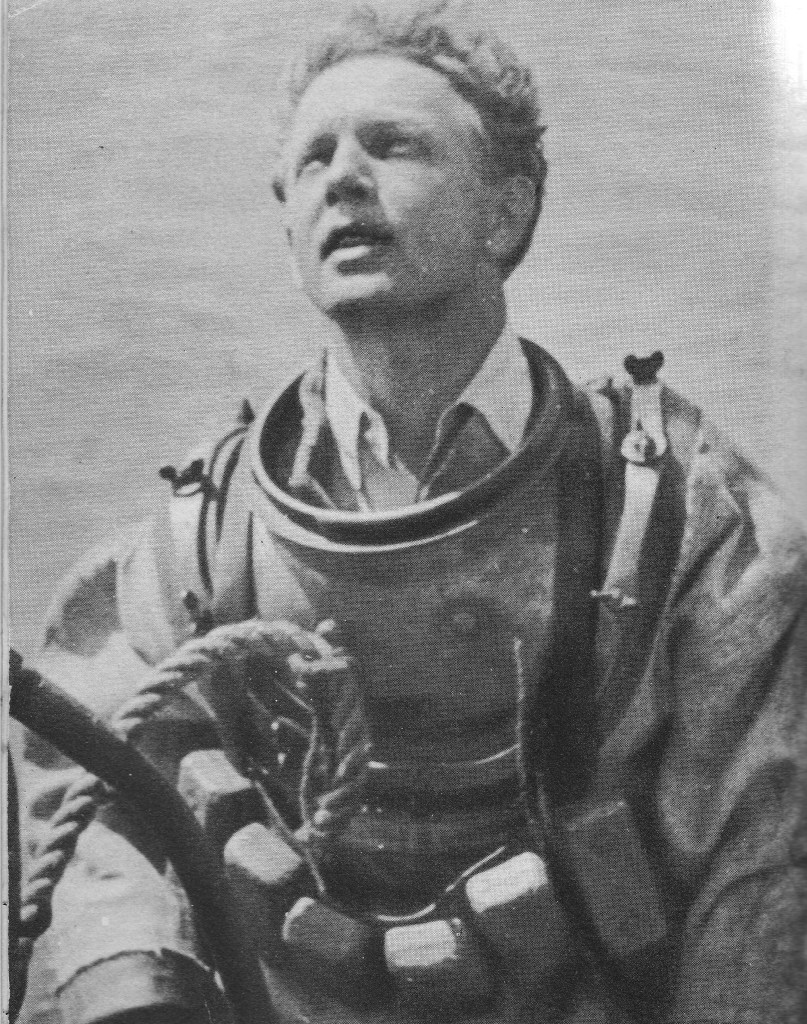
John Ernest Williamson (1881 – 1966) was a British-born photographer whose pathbreaking work in Bahamas underwater photography began when his Virginia-based father, Charles Williamson, invented what he called a ‘submarine tube’: a spherical diving bell for use in salvage operations. John and his brother George spotted an opportunity for use in underwater photography and used their father’s model to develop the Williamson photosphere.
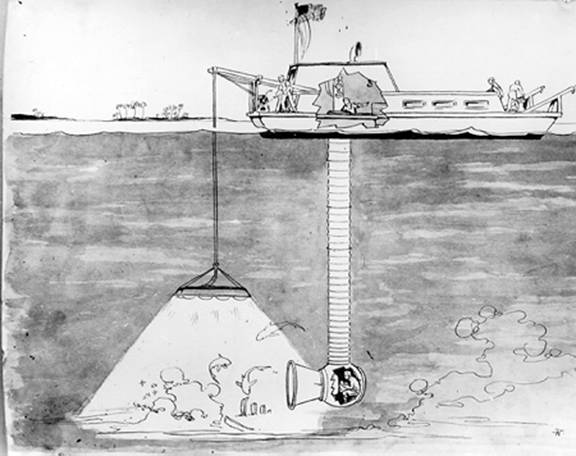
The photosphere was a steel photographic chamber that was lowered into the water from a ‘mother ship’. The chamber was equipped with thick clear glass windows, and powerful electric lights were used to illuminate the underwater world. The spherical chamber has been likened to an underwater aquarium, in which photographers sat and gathered still and moving images of undersea worlds. (Fig 2).
After successful early experiments in underwater still photography using the photosphere, the Williamson brothers developed a plan for shooting motion pictures. The Bahamas was chosen as the filming location for its optimal underwater conditions, including a lack of river sediment, and unusually shallow waters that inhibit the proliferation of micro-organisms and allow light reflection from brilliant white sand and coral seafloors.
Fig.1 John Ernest Williamson, ca. 1915/16 Source: J.E.Williamson, Twenty Years under the Sea (Hale, Cushman & Flint, 1936), n.p.
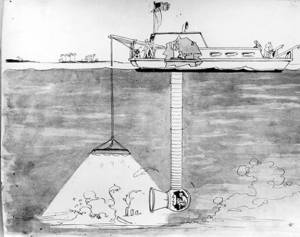
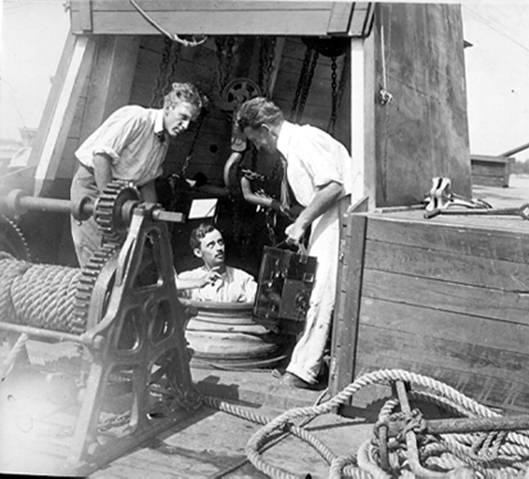
Fig. 2. Sketch (L) of method of underwater photography used by Carl Louis Gregory in 1914. Carl Louis Gregory estate, courtesy of Ralph Graham, M.D. (M-3) Source: Thanhouser Company Film Preservation, Inc.
Fig. 3. Carl Gregory (R), John and George Williamson, n.d. Courtesy of Dominick Bruzzese (X-266-1) Source: Thanhouser Company Film Preservation, Inc
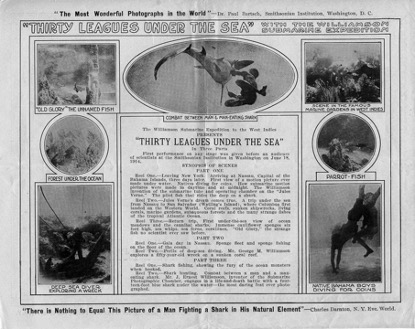
In the wake of this first dazzling encounter with Nassau, the Thanhouser cameraman, Carl Gregory, would shoot 20,000 feet of undersea footage. The earliest surviving footage from this pioneering work, a film titled In the Tropical Seas (1914), is featured on this website with the kind permission of the Thanhouser Corporation. An introduction by Ned Thanhouser explores the genesis of the first Williamson films, explaining how funds were raised from the Corporation for the Williamson project, and detailing the enthusiastic US reception of the two 1914 underwater titles that it generated, The Terrors of the Deep and Thirty Leagues under the Sea.
Williamson’s interwar underwater experiments would later culminate in the launch of an underwater post office devised in partnership with the Nassau Development Board and using the Williamson photosphere as an attraction to feed the islands’ burgeoning tourist trade. The original of the video featured here is held at the EYE Film Museum in Amsterdam. As early film scholar Ivo Blom explains, the footage is ‘either the final reel of Thirty Leagues Under the Sea or additional footage not used in the two Thanhouser releases, here assembled in a special Dutch or European release by a Dutch distributor or exhibitor.’
Films of interest
Terrors of the Deep (Carl Louis Gregory, 1914)
Thirty Leagues under the Sea (Carl Louis Gregory, 1914)
Twenty Thousand Leagues under the Sea (Stuart Paton, 1916)
Further reading
Nicolette Bethel, Navigations. The Fluidity of Identity in the Post-Colonial Bahamas. D.Phil diss., University of Cambridge, 2000.
Jon Crylen, ‘Aquariums, Diving Equipment, and the Undersea Films of John Ernest Williamson,’ in James Leo Cahill & Luca Caminati, eds., Cinema of Exploration. Essays on an Adventurous Film Practice. London & New York: Routledge, 2020, Ch.9.
Jonathan Christopher Crylen, The cinematic aquarium: a history of undersea film, PhD (Doctor of Philosophy) thesis, University of Iowa, 2015. Available at Iowa Research Online.
Ann Elias, Coral Empire. Underwater Oceans, Colonial Tropics, Visual Modernity. Durham and London: Duke University Press, 2019
Ulf Hannerz, Caymanian Politics: structure and style in a changing island society.
Stockholm: Stockholm Studies in Social Anthropology, 1974.
Sonia Schechet Epstein and Sam Benezra, ‘Nautical Film’, Sloan Science and Film, July 13, 2018.
Nicole Starosielski, ‘Beyond fluidity: A cultural history of cinema under water’, in Stephen Rust, Salma Monani & Sean Cubitt, eds., Ecocinema Theory and Practice. Taylor and Francis, pp. 149-168.
Krista A. Thompson, An Eye for the Tropics. Tourism, Photography, and Framing the Caribbean Picturesque. Durham and London: Duke University Press, 2006
Links
Q.David Bowers, Terrors of the Deep, Thirty Leagues under the Sea, in Thanhouser Company Film Preservation, Inc., Thanhouser Films: An Encyclopedia and History. Version 2.1: Volume II: Filmography.
 Bahamas Film Culture Project